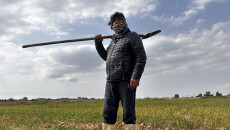



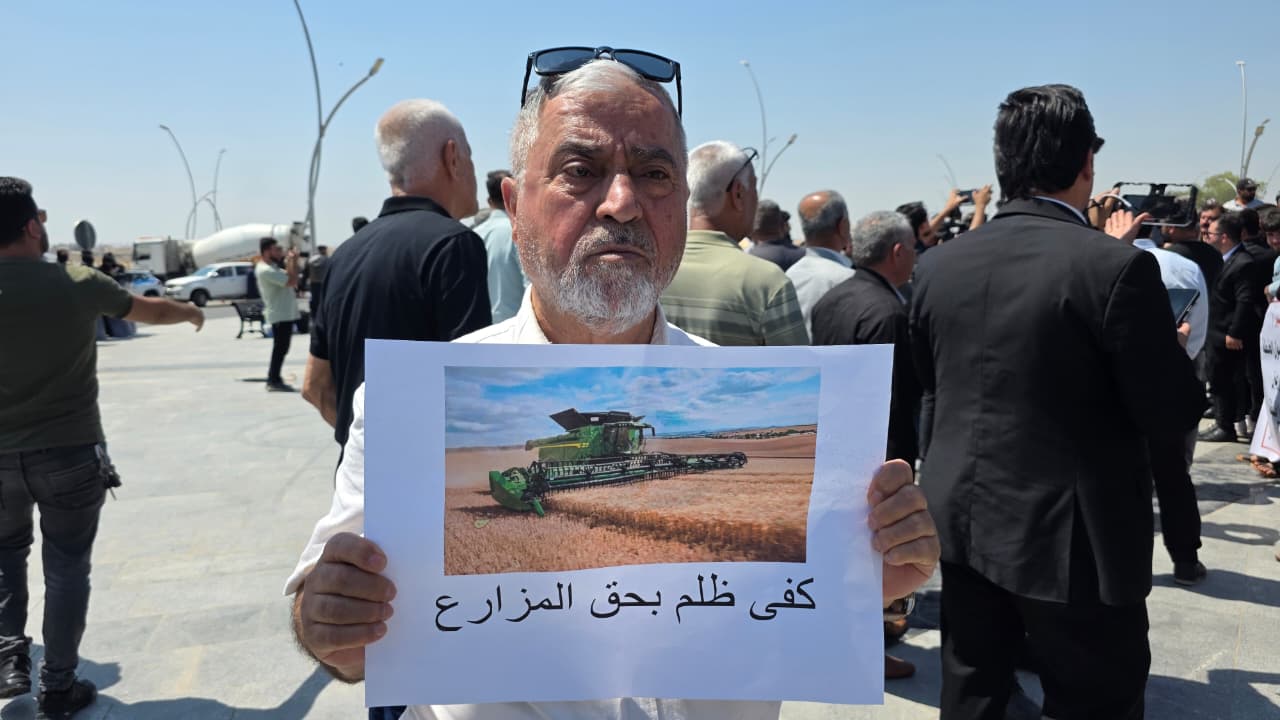

Farmers in the multi-ethnic, oil-rich Kirkuk province have taken to the streets to protest what they describe as unfair treatment of their crops in a province long regarded as one of Iraq’s key agricultural and economic centers.
Over the past two weeks, a series of demonstrations has swept across the province, culminating in a protest on Sunday, June 8, outside the Kirkuk governor’s office. Protesters gathered in front of government officials and local representatives, declaring, “We will not accept this injustice and will continue our protests.”
The demonstrations were triggered by the Iraqi government’s decision to purchase grain produced on land outside the official agricultural plan at a reduced rate of 500,000 Iraqi dinars IQD (USD325) per ton, instead of the fixed price of 700,000 IQD. Farmers say approximately 100,000 hectares in Kirkuk fall into this category after being cultivated with wheat and barley despite not being included in the government’s agricultural plan.
Farmers are also angered by lengthy delays at security checkpoints, where agricultural products are often held for hours. They argue that these delays cause fruits and vegetables to spoil before reaching markets or storage facilities.
Both measures are unjust
“Both measures are unjust and place a heavy burden on farmers,” said Mohammed Amin, a representative of farmers in the Sargaran sub-district. “Kurdish and Turkmen farmers are suffering the greatest losses.”
According to Amin, grain prices have already declined compared with last year, dropping from 850,000 IQD/ton to 750,000. Farmers whose land falls outside the agricultural plan receive only 500,000 IQD/ton, despite spending an estimated 400,000 IQD to produce each ton of grain.
Mahdi Zain al-Abdin, deputy director of the Kirkuk Agriculture Office, said farmers had been informed of the Ministry of Agriculture’s decisions regarding land included in the agricultural plan. He noted that fewer areas were incorporated into the plan this year compared with the previous season.
While some farmers believe the issue is linked to land ownership disputes or discrimination against Kurdish and Turkmen communities, Zain al-Abdin said the decision was primarily aimed at protecting groundwater resources and aligning production with government storage and procurement capacities.
Kirkuk remains one of Iraq’s leading grain-producing provinces, although officials have not yet determined this year’s total harvest. Despite rainfall levels being roughly double those of last year, agricultural authorities expect production from officially planned land to remain similar to last year’s levels. Additional output from land outside the plan could further increase total production.
In 2025, farmers in Kirkuk produced approximately 503,000 tons of grain, compared with 547,000 tons the year before.
We question why so much of the land excluded from the agricultural plan belongs to Kurdish and Turkmen farmers
However, repeated government explanations have done little to ease farmers’ frustrations.
“We question why so much of the land excluded from the agricultural plan belongs to Kurdish and Turkmen farmers,” Amin said. “We demand that grain be purchased at the same rate as last year and that crops grown outside the plan be treated fairly.”
Iraqi farmers rely heavily on government support for grain production, a system that experts have criticized for years. Critics argue that large quantities of grain have been stored in silos without proper use, while financial resources were often insufficient to compensate farmers. As a result, many farmers prefer selling their crops to private traders and silos, especially as global demand for wheat has increased following Russia’s invasion of Ukraine, Europe’s breadbasket.
The Iraqi government purchases wheat from farmers at prices ranging from 500,000 to 850,000 IQD/ton — approximately $350 to $600 — depending on the grain’s quality.
The Ministry of Agriculture assists farmers by supplying harvesting equipment, seeds, fertilizers, and pesticides either free of charge or at subsidized prices. Farmers continue to demand stronger government support due to ongoing challenges as dust storms, and the rising costs of fertilizers, pesticides, and other essential agricultural supplies.
Ahmed Kirkuki, a member of the Kirkuk Provincial Council, described the situation as unacceptable. “The injustice facing Kurdish and Turkmen farmers cannot continue,” he said, calling on parliament to intervene and address the issue.
Kirkuk silos began receiving grain deliveries on June 1. This year, 16 new storage facilities were constructed, providing capacity for an additional 150,000 tons of grain, according to Hassan Hamdi, director of the Kirkuk silo authority.
Rakan Saeed, a member of the Agriculture and Irrigation Committee in the Kirkuk Provincial Council, urged the government to pay farmers on time. “It is unfair that farmers have not yet received their 2025 payments while they are already delivering their 2026 harvest,” he said.
Saeed added that many of the current regulations affecting agricultural land and farmer compensation were adopted by a previous Council of Ministers and should be reviewed by the current government.
“Regardless of any mistakes or a farmer’s background, people have invested their money and deserve support,” he said. “We stand with the farmers and reject these policies.”
It makes no sense to live in the same province and still be prevented from bringing your produce into the city
Checkpoint restrictions have become another major source of frustration. Farmers have repeatedly demanded the removal of barriers that slow the transport of agricultural goods into Kirkuk city.
“It makes no sense to live in the same province and still be prevented from bringing your produce into the city,” said Abdullah Mohammed Daud, a farmer from Topzawa village.
According to farmers, Kurdish producers have been particularly affected by restrictions linked to government directives limiting the movement of agricultural products originating from Kurdistan Region provinces into Kirkuk and other parts of Iraq.
Hawraz Shuani, director of the Shwan sub-district, said security forces are currently enforcing those regulations, resulting in lengthy inspections and delays.
“Some agricultural products, especially fruits and vegetables, cannot withstand being held at checkpoints for several hours,” he said.
The governor is responsible for security and administration, but the problem is that he lacks sufficient authority
The northern, oil-rich, ethnically mixed province of Kirkuk is home to over 2 million Kurds, Turkmen, and Arabs. Located 238 kilometers north of Baghdad, Kirkuk has long been at the center of disputes between the federal government in Baghdad and the Erbil-based Kurdistan Regional Government KRG.
Mazen Gharib, a member of parliament representing Kirkuk, criticized military involvement in regulating agricultural trade. He argued that crops grown within the province should not face such restrictions.
“The governor is responsible for security and administration, but the problem is that he lacks sufficient authority,” Gharib said.
He also stressed that “the military’s role should focus on border protection and security rather than managing internal trade and customs procedures.”
In response to growing complaints, several members of parliament and the provincial council met with the commander of joint operations in Kirkuk on June 8 to discuss the issue.
Before the meeting, Ahmed Kirkuki accused some checkpoint personnel of demanding bribes and extorting money from drivers and farmers, saying there were numerous complaints about checkpoint practices.
Later, Brigadier Omar Waili, head of Iraq’s Border Gates Authority, visited the Daraman checkpoints on the Erbil road and the Chiman checkpoint on the Sulaymaniyah road. During the visit, he instructed officials to facilitate trade, speed up procedures, reduce bureaucracy, and ensure smoother movement of goods between provinces.