



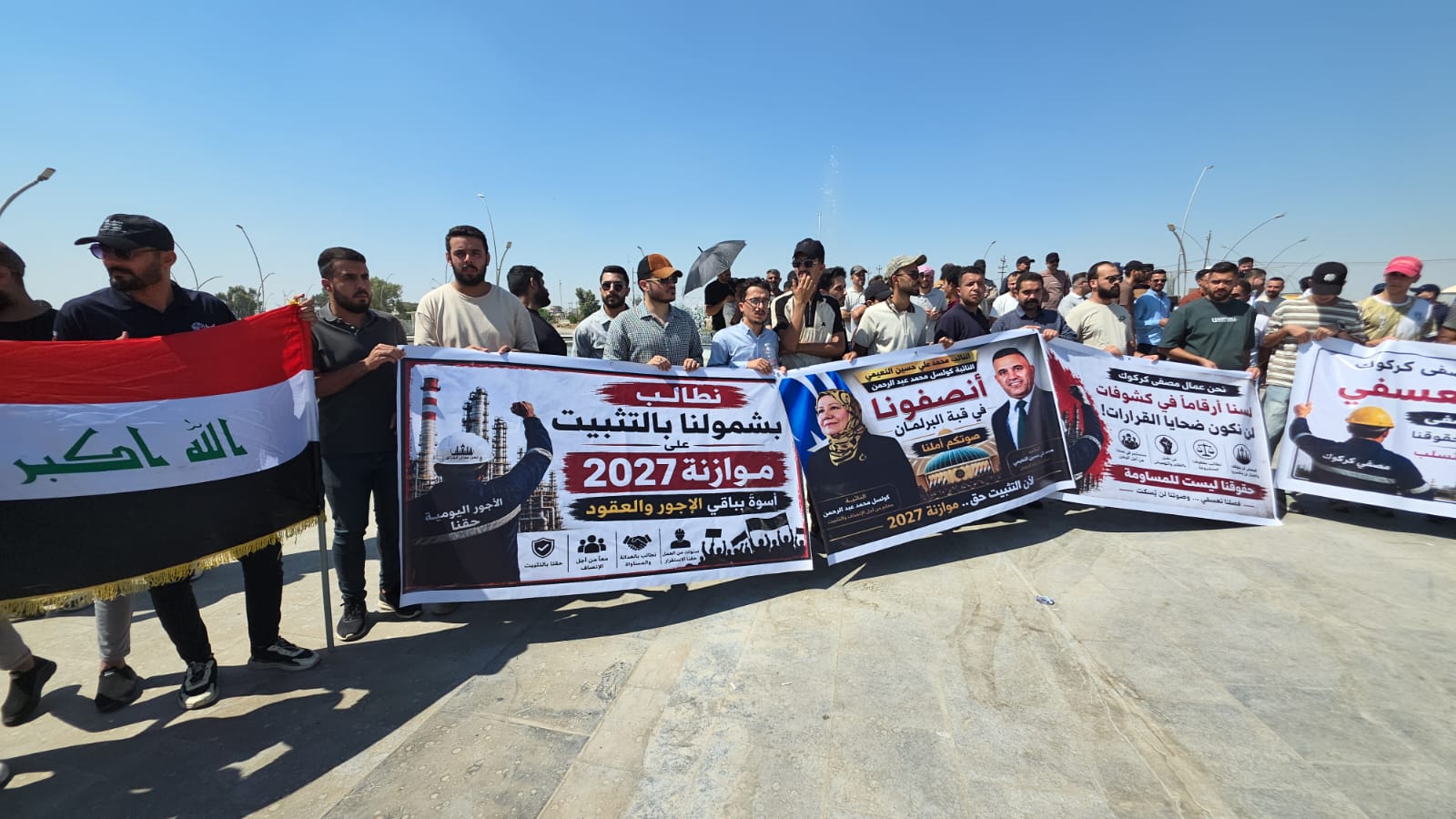

Hundreds of workers and engineers from the Kirkuk refinery in the Arafa neighborhood gathered outside the Kirkuk governor’s office on Tuesday, demanding that they be allowed to return to work.
At least 610 workers and engineers, who had been employed for years by Iraq’s Oil Ministry on a daily-wage basis, have had their work suspended. The employees say they have been caught up in a corruption investigation involving the Northern Refineries Company and allegations surrounding former refinery official Adnan al-Jumaili.
The protesters blocked the entrance to the governor’s office, calling for their reinstatement and rejecting a proposed change to their employment arrangements.
“We have worked at the Kirkuk refinery for six or seven years. Then, one day, we were told that our employment system would be changed from daily wages to another system,” said Haitham Yousef, one of the demonstrators. The proposed arrangement is known in Arabic as (purchase of services).
Under this system, which has been used by several Iraqi government ministries, a ministry contracts a private-sector company to provide workers and other services required by the ministry.
The Northern Refineries Company has asked its workers and engineers to complete forms changing their employment status from daily wages to the purchase-of-services system. However, the employees have rejected the proposal, arguing that it could prevent them from obtaining permanent state employment, something they say they have sought for years.
They also fear that the new arrangement could result in lower salaries, heavier workloads, or even dismissal.
The proposed changes come amid an Oil Ministry investigation into approximately 11,600 daily-wage workers employed by the Northern Refineries Company.
According to a source close to the Northern Oil Company, the ministry’s investigation found that only around 4,500 of the workers could be verified as having actually worked on a daily basis through fingerprints, signatures, and employment records. The findings have reportedly raised concerns within the ministry.
“Yes, the Oil Ministry investigation is real, but the fake workers were not at the Kirkuk refinery. We can prove that we worked there every day. There are around 600 men and women among us,” Yousef said.
Arab MP Mohammed Ali Tamimi addressed the protesters outside the governor’s office and pledged to support their demands. He said the workers should not be punished for alleged corruption involving other employees.
“You have fingerprints, security clearances, and years of service. The problem is not with you; the problem is with those who were bribed and those whose employment records were fabricated,” Tamimi told the demonstrators.
Yousef said the workers would lose important rights if they were transferred to the purchase-of-services system.
“If we change our employment status from daily wages to service contracts, we will lose all our rights. We must not become victims of corrupt or fictitious employees,” he said.
The protesters are demanding official reinstatement as well as payment of their outstanding wages and financial entitlements for the previous four months.
Tamimi said a joint committee from the Oil and Planning ministries is examining the case and called on the workers to remain calm while the investigation continues.
He also described alleged discrepancies in payments to refinery workers and engineers. According to Tamimi, the Oil Ministry allocated 55,000 Iraqi dinars IQD ($35) per day for each worker, while workers reportedly received only IQD25,000. For engineers, he said, IQD125,000 were allocated per day, while only IQD50,000 were paid.
The Northern Refineries Company oversees several refineries in northern Iraq, including the Beji refinery. Adnan Jumaili previously supervised the Beji refinery before becoming deputy oil minister for refinery affairs.
The International Labor Organization (ILO) reported that the unemployment rate in Iraq has risen from 9% in the early 1990s to 14.2% in 2021.
Out of 40 million Iraqis, 9.2 million are employed, while Iraq's state-dominated economy is led by the oil sector, which provides approximately 85% of state revenue. The government now pays 400% more in salaries than it did 15 years ago. Around three-quarters of the state's expenditures in 2020 went to paying civil servants in the public sector.
A source close to the Northern Oil Company said the Oil Ministry’s efforts are aimed at reorganizing refinery operations, addressing corruption, and removing employees whose positions were allegedly created through fraudulent or improper means.
“The arrest of Jumaili and some of his associates has helped expose this corruption,” the source said.
In Kirkuk, the protesters are awaiting a response from the relevant authorities. However, given the complexity of the investigation, it remains unclear how quickly their employment status and financial claims can be resolved.
“We are working to find a legal and administrative solution to return the workers to their jobs and pay their financial entitlements for the past four months,” said Ahmed Kirkuk, a member of the Kirkuk Provincial Council.
Iraq has witnessed a sharp increase in national poverty rate from 20% in 2018 up to 31.7% in 2021and the total number of poor to 11.4 million as a socio-economic impact of the Covid-19 pandemic, shows an assessment by the Iraqi Ministry of Planning with the support of UNICEF, World Bank, and Oxford Poverty and Human Development Initiative.
“We have raised these issues with the Oil Ministry and submitted the relevant demands. We will continue to follow up on the investigation,” MP Mohammed Ali Tamimi added.