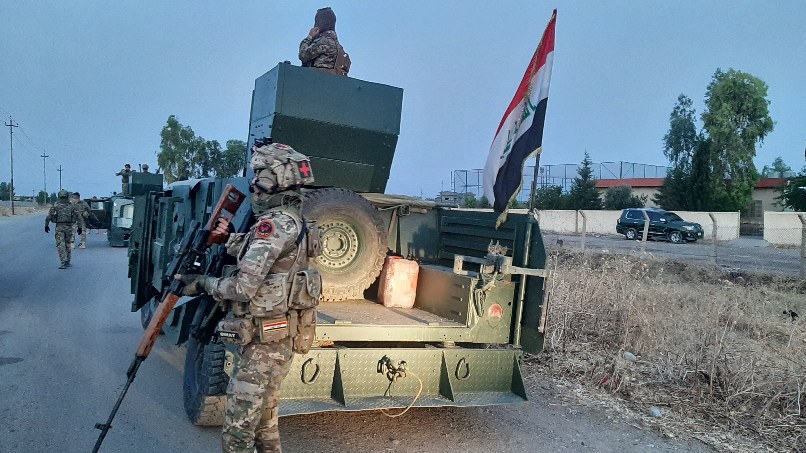

Acting on the orders of the Commander-in-Chief of the Armed Forces, Iraq’s Ministry of Defence has deployed the 17th Division of the Iraqi Army to Hawija District, southwest of Kirkuk.
The deployment brings the number of military divisions responsible for securing Kirkuk province to three. Despite this reinforcement, calls continue for the establishment of joint security forces to address security gaps in areas between the Kurdistan Regional Government KRG and the federal government.
Mazen Gharib, a Kirkuki member of parliament and member of the Security and Defence Committee, explained that the 17th Division assumed responsibility for security in Hawija and its surrounding sub-districts on Tuesday, October 20, replacing the 3rd Division of the Federal Police.
Gharib confirmed that the deployment coincided with a high-level meeting of military commanders at the Ministry of Defense in Baghdad. The meeting focused on developing comprehensive security plans to address areas lacking adequate security coverage between the Kurdistan Region and the federal government, particularly in Kirkuk province.
To strengthen security in these vulnerable areas, Gharib proposed establishing two joint brigades made up of local residents. He noted that a similar arrangement had previously been implemented in Tuz Khurmatu and Makhmur.
“A specialized joint force consisting of the city’s own residents must be formed. Both governments need to reach an agreement and work toward closing these security gaps by establishing two such brigades,” he said.
Kirkuk, a strategically important, oil-rich province in northern Iraq with a diverse ethnic population of over 2.34 million, continues to be a contested territory between the Iraqi federal government and the KRG. The province’s political future is linked to Article 140 of the Iraqi Constitution, which provides for a process of normalization, a population census, and a referendum to determine its status.
The deployment comes amid a series of security incidents that authorities have attributed to increased activity by Islamic State (ISIS) elements. These developments have raised concerns about the safety of security personnel and residents of villages across the province.
Earlier in the month, an armed group identified by security forces as ISIS members attacked a military checkpoint in Hawija District, resulting in clashes. In a separate incident, an improvised explosive device detonated in the Al-Rashad sub-district, killing two Iraqi Army officers and one soldier.
The 17th Division comprises three brigades, giving it greater manpower than the Federal Police division previously stationed in Hawija. That unit, which consisted of two brigades, had been redeployed to Baghdad.
Two other Iraqi Army divisions are also responsible for maintaining security across Kirkuk province. The 8th Division operates in the northern and northwestern areas, including Dibis, Altun Kupri (Prdy), Shwan, and Sargaran. Meanwhile, the 11th Division is stationed in Daquq District and covers the southern areas of Taza, Al-Bashir, and Yaychi.
On Wednesday, October 21, Shakhwan Abdullah, head of the Kurdistan Democratic Party (KDP) parliamentary bloc in the Iraqi Parliament, visited Kirkuk alongside a delegation from his bloc. During a press conference, he criticized the absence of Kurdish representation in the province’s security institutions.
“There is not a single Kurd holding a position of responsibility within any security institution in the province—from the Operations Command down to all other security agencies. This represents a grave injustice and unfairness toward the Kurdish community. We remained silent because the formation of the [local] government—under Ali al-Zaidi—was not yet complete. Now that the government is fully formed, we will raise this issue in Baghdad,” Abdullah stated.
He also called for the return of Peshmerga forces to Kirkuk as part of a joint security arrangement, arguing that their participation was necessary to address areas where security gaps remained.
“The Peshmerga forces must return—as part of a joint force—to areas currently experiencing a security vacuum,” he said.
Kirkuk’s 16-member Provincial Council is divided among several political and ethnic groups. Arab representatives hold six seats across three blocks, while Kurdish parties occupy seven seats, including five held by the Patriotic Union of Kurdistan (PUK) and two by the Kurdistan Democratic Party (KDP). The Iraqi Turkmen Front (ITF) holds two seats, and the remaining seat is allocated to the Babylon Movement, which represents the Christian community.