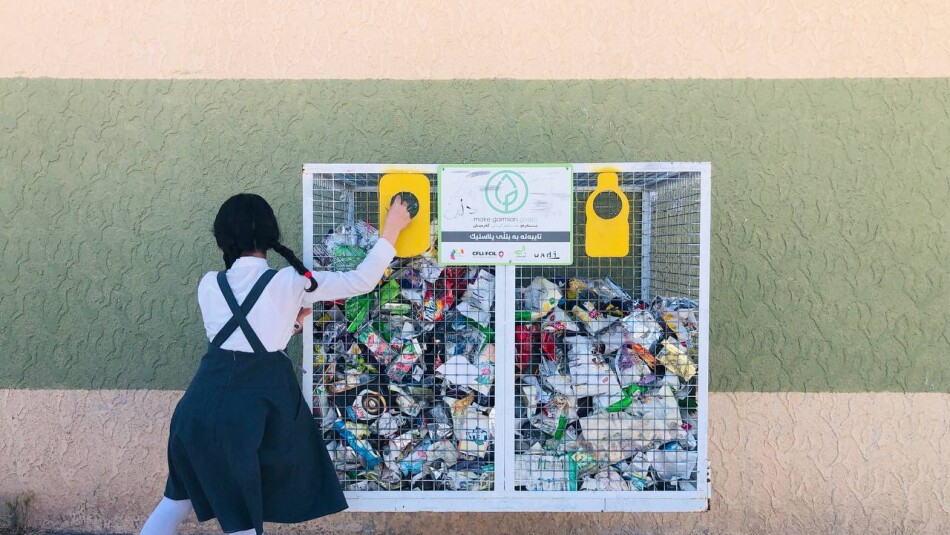
Women in Kifri district of Garminan, SUlaymaniyah province, are taking an active role in tackling plastic pollution and promoting a cleaner, healthier environment through an initiative launched by a local organization. The campaign encourages residents to collect plastic waste in designated containers installed across neighborhoods and public spaces, preventing it from polluting the environment and allowing it to be recycled.
The initiative involves placing metal collection boxes along streets and in selected public areas for residents to dispose of plastic materials instead of mixing them with household waste.
Iman Hassan, a member of the recycling center at ADWI Organization in Kifri district, said the response from residents had exceeded expectations.
“We did not expect our initiative to receive such a positive response. Initially, we installed the boxes in just one neighborhood and a few public places as a trial. However, within two or three days, women from the neighborhood began calling us to say that the boxes were already full and needed to be emptied,” Iman said.
ADWI, which works to raise awareness and support the development of women and children in Iraq, is implementing the initiative as part of a project funded by the German Federal Ministry for Economic Cooperation and Development. The project is titled “The Future Through Innovation: Together for Climate and Local Development.”
We did not expect our initiative to receive such a positive response
Women and children in Kifri have become key participants in the initiative, helping collect plastic waste, protect the collection boxes, and promote environmental awareness. ADWI's teams also explain the harmful effects of plastic pollution and the importance of keeping neighborhoods clean.
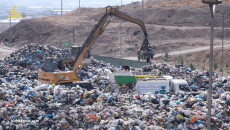
Garbage collection was duty of public municipalities while now it is carried out by private companies who have contracts with the local administrations. Garbage collection trucks gather waste from houses who have one plastic dustbin for all types of waste, later taken for burial in a landfall.
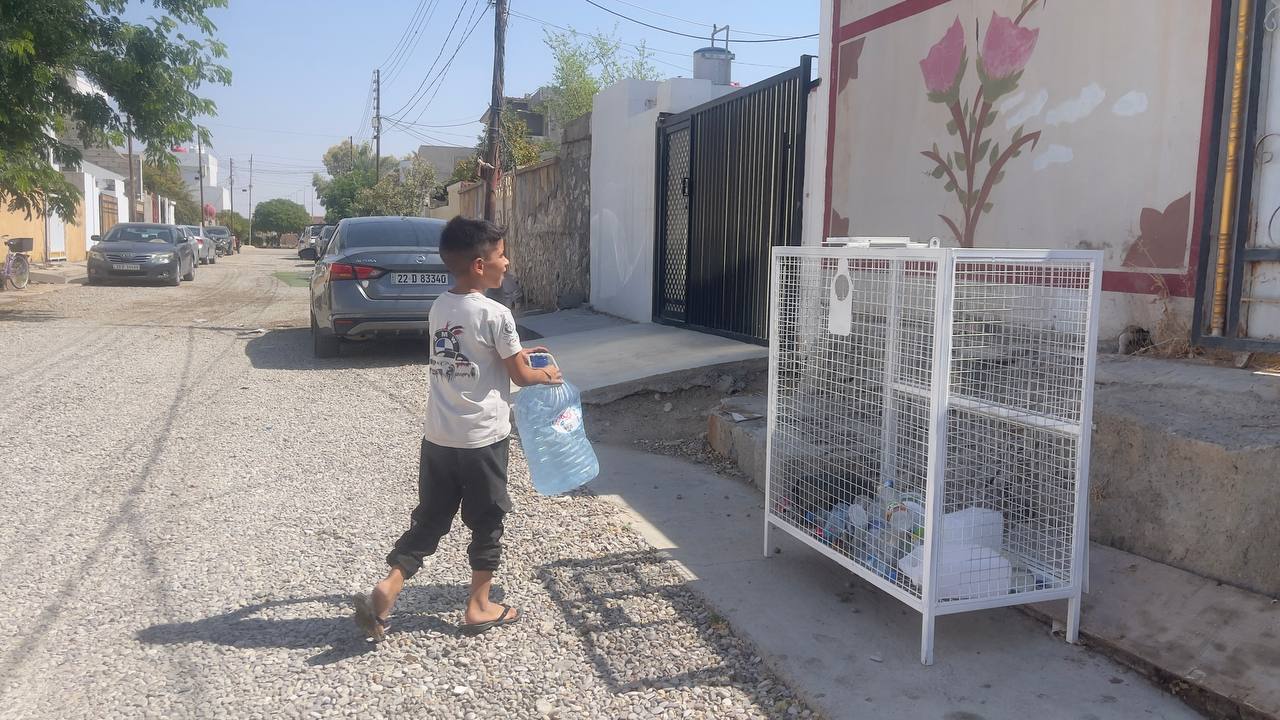
Women and Children Embrace the Initiative
Shilan Mohammed, 41, a resident of Shorsh neighborhood, where the collection boxes were first installed on a trial basis, said the initiative had attracted considerable attention from local residents.
“The installation of the boxes has become a major topic of conversation among women and children. Everyone, young and old, wants to take part,” she said.
Mohammed explained that plastic waste had previously been mixed with household garbage and either burned or buried, rather than collected separately for recycling.
“Since the boxes were installed, people have become much more interested in collecting plastic instead of throwing it away with other waste,” she added.
According to United Nations warnings, plastic pollution can affect reproductive health, hormonal function, and brain activity. It also contributes to air pollution and poses broader risks to human health.
Kifri district is considered one of the disputed territories under the Iraqi constitution, though administratively it falls under the Garmian administration. According to 2023 data, Garmian’s green coverage stands at just 5.7 percent—well below the international standard of 30 percent.
The population of the Garmian administration is estimated at 343,594 people, according to data from the Garmian Directorate of Statistics. Meanwhile, figures from the General Directorate of Municipalities in Garmian show that the area contains 243 large public parks and gardens, including 83 located in the Kifri district.
According to the Kurdistan Regional Government’s Ministry of Health, environmental pollution is considered one of the factors contributing to cancer. In 2023, a total of 9,911 cancer cases were recorded in the Kurdistan Region, with lung cancer ranking as the second most common type. Across Iraq, the Ministry of Health reported more than 43,000 cancer cases during the same year.
Although Mohammed was aware that plastic could be harmful, she said she had not previously understood the full extent of its effects.
“I know and have heard that plastic is harmful, but I do not know exactly what the dangers are,” she said. “We support ADWI and hope the organization will install more collection boxes in our neighborhoods.”
Ali Nihad, 12, who lives in the same neighborhood, is among the children actively participating in the campaign.
“I keep a close eye on the box and will not let anyone damage it. I also tell the other children in the neighborhood to protect the boxes and collect plastic,” he said.
I keep a close eye on the box and will not let anyone damage it
His involvement reflects the role children are playing in encouraging their families and neighbors to adopt better waste-disposal practices.
During the initiative's first phase, ADWI installed 28 collection boxes in Kifri and nine in Kalar district.
Alongside installing the boxes, the organization's teams are conducting awareness activities for women and children, focusing on environmental cleanliness, plastic pollution, and the consequences of improper waste disposal, Iman Hassan said.
Sharmin Ibrahim, 65, also welcomed the campaign and said she had changed how she disposed of plastic waste.
“Since the day the teams came and installed the boxes, I have stopped throwing away the plastic containers and bottles I collect. Instead, I put them in the designated boxes,” she said.
The containers are used to collect various plastic items, including bottles for water, oil, and shampoo, as well as other household packaging.
Turning Plastic Waste into Reusable Products
ADWI, in partnership with WADI, Germany-Iraqi NGO, has established a small recycling facility in the center of Kifri district. The facility processes at least 50 kilograms of plastic each day, crushing and melting the material before transforming it through several stages into new products, including pots, chairs, and tables.
“When the collection boxes are full, we transport the plastic to the center, sort it, and recycle it,” Iman explained.
The initiative addresses a broader waste-management challenge across the Garmian administration. According to local administration statistics, approximately 500 tons of waste are collected daily in the area. However, the waste is not separated into different categories, meaning large quantities of plastic—including water bottles, cleaning-product containers, and plastic bags—are disposed of alongside other garbage.
The United Nations has outlined efforts to reduce global plastic pollution by 80 percent by 2040 through changes in production, consumption, and waste management. These measures include promoting reuse, expanding recycling, and replacing conventional plastics with alternative materials.
ADWI's team members say the positive response from residents has encouraged them to expand the initiative. However, installing additional collection boxes remains challenging because of the associated costs.
“We are pleased to see women and children participating in this important initiative. They are directly exposed to plastic products in their daily lives, and it is encouraging that they are increasingly aware of the harm caused by throwing plastic waste away or burning it, both for the environment and for human health,” Iman said.
She added that the organization's next priority is to install more collection boxes in residential neighborhoods and expand public awareness through direct meetings with residents.
By combining community participation, environmental education, and local recycling, the initiative aims to reduce plastic pollution in Kifri while encouraging women and children to play a greater role in protecting their surroundings.
This story was produced by the KirkukNow team as part of the project “The Future Through Innovation: Together for Climate and Local Development,” implemented by ADWI in the Kurdistan Region of Iraq and funded by the German Federal Ministry for Economic Cooperation and Development.